Technology has changed dramatically over the past several years. The way organizations use technology has changed with it.
Employees work from offices, homes, job sites, client locations, and everywhere in between. Business information may live on computers, servers, cloud applications, mobile devices, and dozens of other systems. Cybersecurity threats increasingly target people and identities just as much as computers. Insurance carriers, customers, regulators, and contracts are placing new technology and security requirements on organizations.
Yet the traditional approach to IT is often still surprisingly simple: wait until something breaks, call someone, and get it fixed.
That is no longer enough.
Throughout the fourth quarter of 2026, Core Integrated Technologies is making one of the largest investments in our service platform since the company was founded. We are modernizing many of the systems, tools, and processes behind CORECare.
But the goal isn't more technology.
The goal is better-managed technology.
IT Has Become Bigger Than IT
There was a time when managing technology largely meant keeping computers running, maintaining a network, installing software, and helping users when something went wrong.
Those things still matter. They are simply no longer the whole job.
A technology problem can now become a cybersecurity incident. A cybersecurity decision can affect insurance coverage or compliance obligations. An undocumented configuration can make recovery more difficult after an outage. A poorly designed process can waste hundreds of hours even when every computer involved is technically working perfectly.
Technology decisions affect productivity, security, compliance, risk, business continuity, customer service, growth, and long-term planning.
That means managing technology well requires a much broader view of the organization.
Security Requires Greater Visibility
Cybersecurity is one of the clearest examples of how IT has changed.
Modern attacks do not necessarily stay within one system. An incident may begin with an email, involve a compromised identity, move through a cloud application, reach an endpoint, and eventually affect other systems across the organization.
Protecting an organization therefore requires more than installing security software on its computers.
It requires visibility.
As part of the next generation of CORECare, we are expanding our ability to monitor and protect the different parts of a client's technology environment. That includes stronger endpoint protection and detection, cloud and identity monitoring, email security, network visibility, backup and recovery, automation, and 24/7 security operations capabilities.
The objective is not simply to add more security products. It is to better understand what is happening across an environment so threats can be prevented when possible, detected sooner, contained more effectively, and recovered from when necessary.
Documentation Is Part of Good IT
Documentation is not usually the most exciting part of technology, but it may be one of the most important.
Good technology management depends on knowing what an organization has, how it is configured, how systems relate to one another, why decisions were made, and what needs attention.
Without good documentation, too much knowledge can live in someone's head. Troubleshooting takes longer. Planning becomes harder. Transitions between technicians become more difficult. Security controls are harder to verify.
Documentation has also become increasingly important outside the IT department.
Cybersecurity insurance applications may ask whether specific controls are implemented. Customers may send security questionnaires. Regulators and industry frameworks may require evidence. Auditors may want documentation showing not only that a policy exists, but that it is actually being followed.
That is why better documentation is a major part of our investment in CORECare for 2027.
Compliance Shouldn't Be a Periodic Scramble
Compliance is another area where the role of an IT provider has changed.
Some organizations have well-known regulatory obligations such as HIPAA or PCI DSS. Others encounter cybersecurity requirements through contracts, customers, insurance carriers, or industry standards.
The worst time to discover a gap is when an audit, insurance renewal, customer questionnaire, or incident is already underway.
We believe compliance should increasingly become part of the ongoing management of technology.
Our expanded capabilities will help us assess environments against applicable requirements, identify and document gaps, develop remediation plans, maintain evidence and documentation, and, in many cases, implement the technical controls necessary to address those requirements.
It changes the conversation from "How do we answer this questionnaire?" to "Are we actually doing what we say we're doing?"
That is a much more valuable question.
Proactive IT Means More Than Monitoring
The word proactive gets used frequently in the technology industry.
To us, proactive IT should mean more than receiving an alert before a hard drive fails.
It means understanding the organization well enough to help make better decisions before technology becomes a problem.
- Where is technology slowing people down?
- Are employees working around systems that don't fit the way the business actually operates?
- Are there tools being paid for that nobody uses?
- Are several applications doing essentially the same thing?
- Are there security or compliance requirements nobody has identified yet?
- Is the organization prepared to recover if an important system becomes unavailable?
- What technology decisions need to be made today to support where the organization wants to be two or three years from now?
Those are technology questions, but they are also business questions.
And they cannot be answered simply by monitoring a computer.
Technology Should Fit the Business
This investment also reinforces a philosophy that has guided Core for years.
Technology should be built around your processes, not prescribe them.
We don't believe the starting point should be a product.
The starting point should be understanding the organization: what it does, how work gets done, who does that work, what requirements apply, where problems exist, and where the organization wants to go.
Only then should technology enter the conversation.
Sometimes the answer is new technology. Sometimes it is better configuration of something already owned. Sometimes it is training, documentation, automation, consolidation, or a change in process.
And sometimes the right recommendation is to change nothing at all.
The objective isn't to deploy the most technology.
It is to use technology intentionally.
Building the Next Generation of CORECare
Throughout the remainder of 2026, we will be putting these ideas into practice as we transition to the next generation of CORECare.
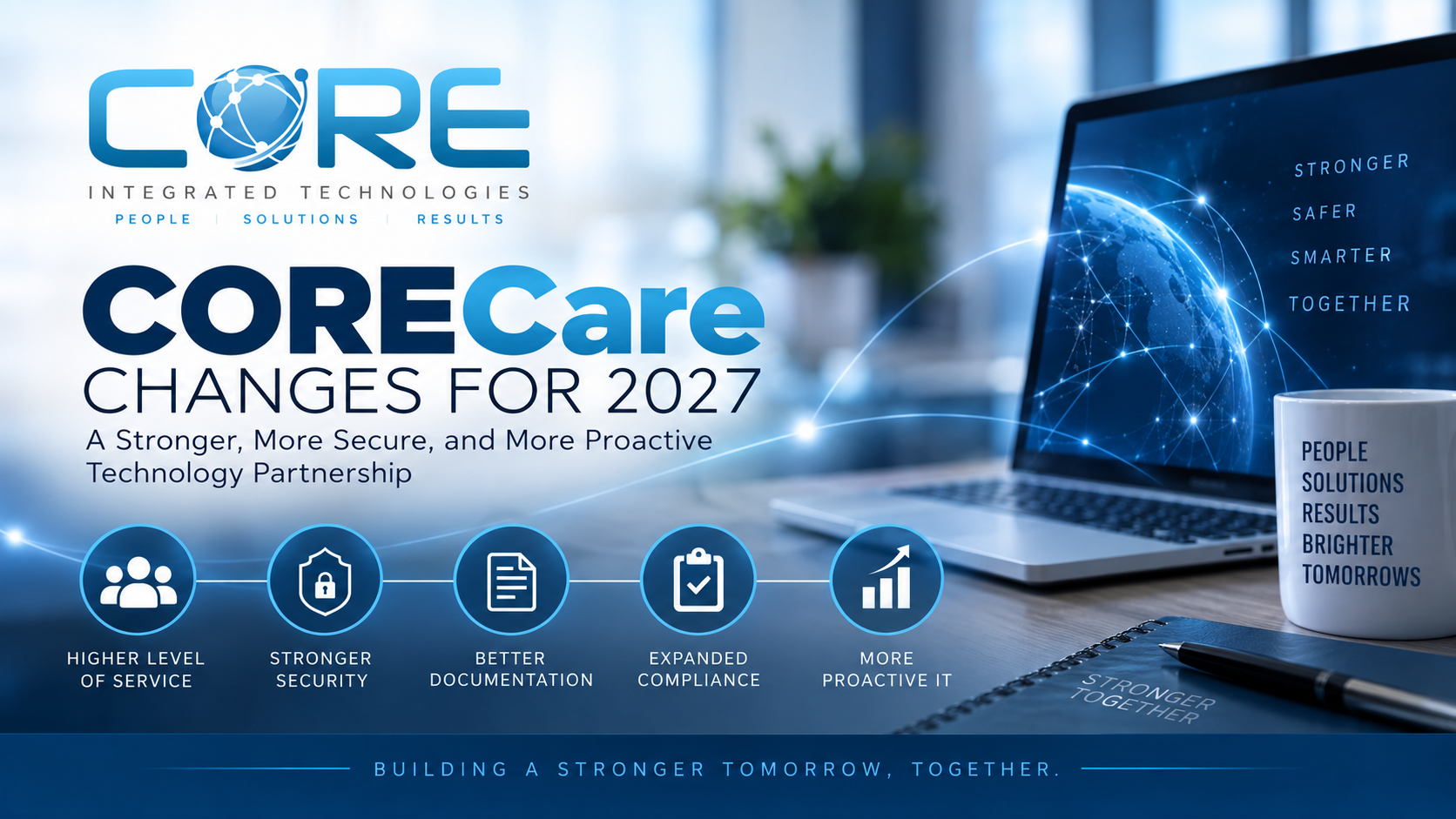
The changes include major investments in the systems we use to deliver service, manage and document client environments, automate routine work, protect organizations from cybersecurity threats, address compliance requirements, and plan technology more proactively.
Many of these changes will happen behind the scenes. Clients may never see some of the technology involved, and that's okay.
What matters is what those investments allow us to do.
Better information.
Better documentation.
Stronger security.
Greater accountability.
More proactive planning.
Technology will continue changing. The threats will change. The requirements will change. The tools will certainly change.
Our responsibility is to keep improving how we bring those pieces together so technology works for the organizations we serve.
That's what we're building into CORECare for 2027.
Learn More About CORECare 2027
Learn more about the CORECare changes for 2027, including what is changing and frequently asked questions.